
The Utilities Regulatory Authority (URA) advises electricity customers in Port Vila and Luganville of the potential impacts of recent global diesel price movements on electricity prices. These developments are linked to ongoing geopolitical tensions involving Iran, Israel, the United States, and several Gulf States.
Note that the URA at this stage has not included the implications of diesel price changes on Tanna and Malekula due to limited data availability for forecasting purposes
1. Relationship between Crude Oil Price and Utility Diesel Price
Vanuatu’s fuel supply is sourced through Singapore, where prices are largely influenced by Dubai crude oil. Due to limited availability of recent and publicly accessible Dubai crude data, URA’s analysis uses West Texas Intermediate (WTI) crude oil prices published by the U.S. Energy Information Administration (EIA) as a proxy, due to the strong positive correlation between the two benchmarks.
Historical data indicates a positive relationship between international crude oil prices and diesel prices paid by utilities in Port Vila and Luganville, with an estimated transmission lag of approximately two to three months from global price changes to domestic utility fuel costs.
The accompanying Graph illustrates the relationship between WTI crude oil prices and utility diesel prices from 2020 to 2026, including projections for April to July 2026. The analysis highlights the following:
- Ukraine–Russia conflict (from 24 February 2022): WTI prices peaked at approximately 83 VT/L in June 2022. Corresponding diesel prices peaked in September 2022 at 174.9 VT/L in Port Vila and 155 VT/L in Luganville, representing a total increase of 79% and 64% respectively. Prices stabilized approximately 18 months after the onset of the conflict.
- Diesel contribution in generation mix: Diesel price trends in Port Vila resemble global oil price movements due to heavy reliance on diesel generation. Diesel reliance increased from 93% in 2022 to 95% in 2025 due to a reduction in renewable energy installed capacity and increased electricity demand. In Luganville, reliance increased from 27% to 44% due to rising electricity demand and fixed hydro capacity. Price differentials between Port Vila and Luganville reflect wharfage and transportation costs.
- Iran conflict (from 28 February 2026): WTI crude prices are forecasted by EIA to increase by 6% in February and 41% in March 2026, followed by a 2% decline in April. Diesel prices for utilities are expected to rise in April by 26% in Port Vila and 13% in Luganville, before easing modestly over subsequent months.
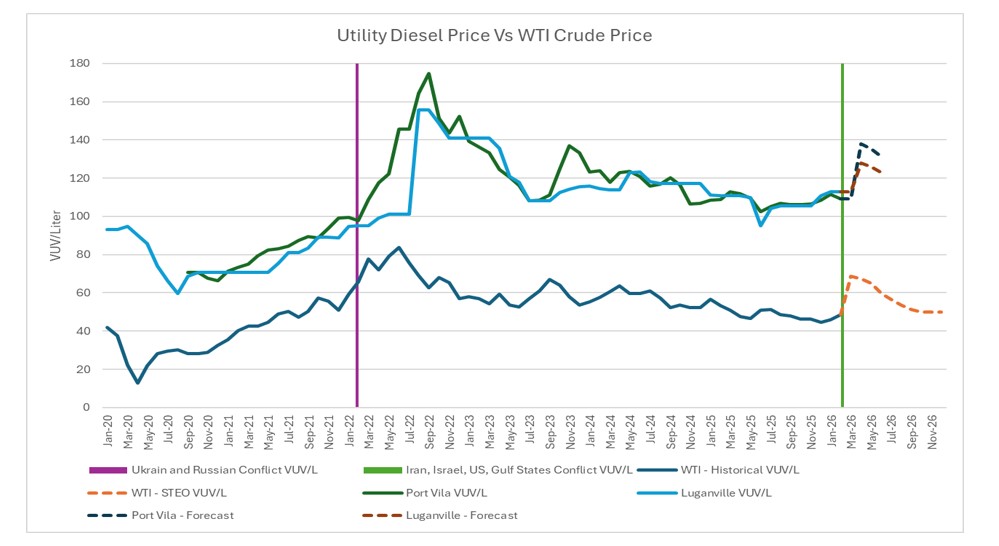
While the forecast shows an increase in diesel price utilized for electricity in April 2026 that will be reflected in the following month’s electricity bills for Port Vila and the following two months for Luganville. The forecast is affected by the following factors that were kept constant in URA’s analysis:
- The exchange rate between VUV and USD;
- The level of renewable energy utilized in electricity generation;
- Vanuatu Government taxes on diesel oil;
- Vanuatu petroleum supplier fuel management decision; and,
- The evolving situation in Iran affecting global supply and demand for petroleum products.
2. Relationship between Utility Diesel Price and Monthly Electricity Bills
Electricity prices in Vanuatu are set on a cost recovery basis, meaning changes in fuel costs are passed directly to consumers through a monthly fuel adjustment for Port Vila and Luganville. Customer categories are defined under the approved tariff structures for each area.
The Table below shows the forecast for month-on-month movements in electricity prices over the next three months. In March 2026, electricity prices are expected to remain stable at 60.00 VT/kWh and 57.11VT/kWh for Port Vila and Luganville, respectively. This stability in prices shows that diesel prices reflect similar prices experienced in February 2026. In April, however, an increase in electricity prices is forecasted, with Port Vila anticipating a higher adjustment of 12.07% compared to a 5.31% increase for Luganville. This difference in price movements reflects the variations in electricity generation mix required in these two locations, with Port Vila being more reliant on diesel-based generation, while Luganville’s moderate price volatility is due to its high reliance on hydro generation.
Three-Month Outlook for Electricity Price
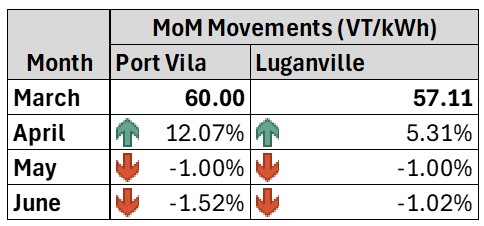
Electricity prices in both Port Vila and Luganville are assumed to decrease by 1.00% respectively for the month of May 2026, while Port Vila prices are projected to decline by a further 1.52% in June compared to a 1.02% expected reduction for Luganville over the same period. Overall, the impact of changes in diesel prices tends to have more effect on electricity bills in Port Vila than Luganville.
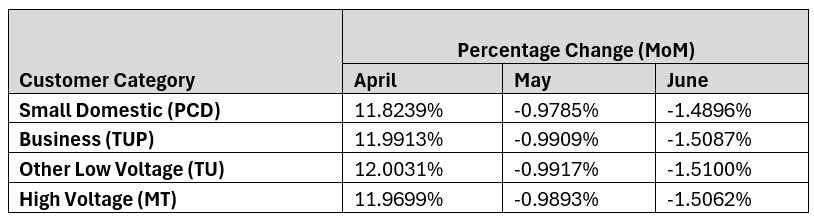
The following table provides the percentage change in the monthly electricity bill movements for the respective months in Port Vila. A similar trend is visible for all Port Vila customer categories, with electricity bills expected to increase to a peak of around 12% in April followed by reductions in May and June as prices begin to ease. It is important to note that the approved prices for the respective months are billed in the following month (M+1) for Port Vila customers.
Percentage Change in Monthly Electricity Bills by Customer Category – Port Vila
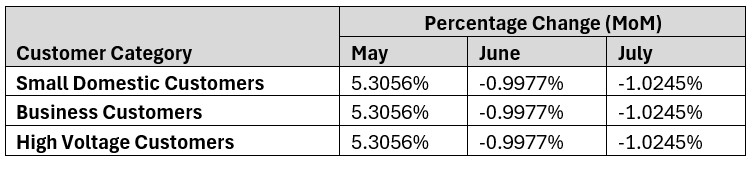
Similar patterns are observed for Luganville consumers as depicted in the Table below. An increase of around 5.3% in electricity bills is anticipated for all Luganville customer categories of Small domestic, Business and High Voltage in May. Electricity bills are expected to decrease slightly in June and July as electricity prices begin to stabilize. As with the billing period for Port Vila, it is similarly important to note that the approved prices for the respective months are billed in the following two months (M+2) for Luganville customer categories.
Percentage Change in Monthly Electricity Bills by Customer Category – Luganville
It is important to understand that the actual electricity bills/invoices may vary depending on the consumption patterns of different customers, the electricity usage, and whether energy efficiency practices are observed. The URA therefore encourages customers to manage their electricity usage efficiently, particularly during periods of high fuel costs. Furthermore, high diesel prices may coincide with periods of high inflation as diesel cost is a key cost driver for goods and services in Vanuatu, therefore managing utility costs may mitigate affordability issues.